CHAPTER IX
Unity Through Truth
The New Testament never treats unity as an achievement.
Modern readers often approach the subject as though unity must be negotiated, protected, or carefully constructed through mutual concession. History has accustomed the church to division, making disagreement appear almost inevitable and unity seem like an ideal forever waiting beyond the next conversation.
Acts begins from an entirely different place.
Luke introduces a church that possesses no centuries of accumulated tradition, no competing schools of thought, and no established institutions capable of holding diverse opinions together. What the first believers share is remarkably simple. They have heard the same gospel, confessed the same Lord, and received the same promise.
Unity is not their destination.
It is their beginning.
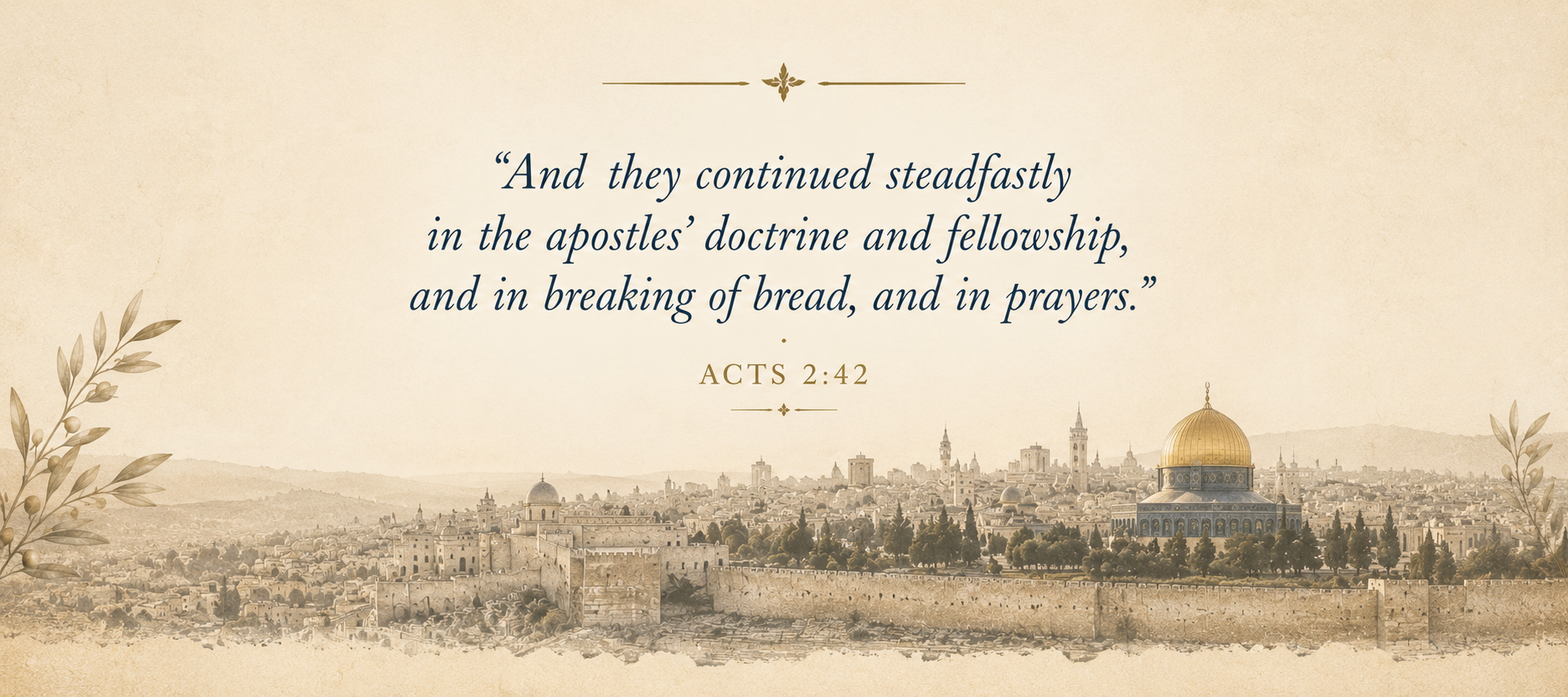
That quiet reality explains why Luke never pauses to discuss it. He simply records ordinary people learning to live an extraordinary life together. Pilgrims who arrived in Jerusalem speaking different languages now gather around the same apostles. Men and women whose histories would never have crossed under ordinary circumstances discover themselves praying together, eating together, worshipping together, and caring for one another with a generosity that surprises the city watching them.
Their fellowship is not built upon similarity.
It is built upon revelation.
The pattern continues as the church moves beyond Jerusalem.
Samaritans receive the Word without becoming a separate church. Gentiles enter the kingdom without a second gospel prepared especially for them. Merchants, laborers, rulers, widows, soldiers, and scholars find themselves standing on the same ground, not because every difference has disappeared but because every difference has become smaller than the Christ who has called them.
Luke never asks the reader to admire this unity.
He simply refuses to explain another kind.
Peter preaches, and Christ remains at the center.
Philip preaches, and Christ remains at the center.
Paul travels farther than any of the other apostles, entering cities shaped by philosophy, commerce, and imperial power, yet the message he carries is immediately recognizable because it is the same message that first echoed through the streets of Jerusalem.
The church expands without multiplying its foundation.
Paul gives language to what Luke has quietly demonstrated from the beginning.
“There is one body, and one Spirit, even as ye are called in one hope of your calling; One Lord, one faith, one baptism.”
The words possess a calm certainty. Paul does not write as a man imagining a future possibility but as one describing a present reality. The church is one because its life comes from one source. Remove that source, and unity becomes little more than agreement maintained by human effort. Remain in that source, and fellowship grows as naturally as branches drawing life from the same tree.
Perhaps this explains why the apostles devoted so much attention to preserving truth.
They understood that unity could never be sustained by personality. Peter would one day die. Paul would finish his course. John would grow old. The church could not depend upon the presence of extraordinary men. It required something far more enduring.
The revelation of Jesus Christ would remain after every apostle had fallen asleep.
Generations would come and go.
Empires would rise and disappear.
Languages would change.
The gospel would cross mountains, deserts, and oceans.
Yet every believer returning to the apostolic witness would find the same Christ standing at the center of the same invitation.
History would eventually surround that invitation with names, movements, and traditions that reflected the sincere convictions of countless communities. Many of those communities would preserve remarkable examples of faith, sacrifice, and devotion worthy of gratitude and respect. The purpose of returning to Acts is not to diminish that history but to remember what existed before history became so crowded.
Luke presents a church whose identity is wonderfully uncomplicated.
Its unity does not rest upon geography, culture, personality, or institution.
Its unity rests upon Jesus Christ.
The farther the narrative travels, the clearer that truth becomes. Every new believer enlarges the fellowship without changing its foundation, and every new city receives the same apostolic witness that first gathered strangers into one body on the Day of Pentecost.
Perhaps that is why Jesus prayed that His followers would be one.
Not because unity would persuade the world by its appearance alone, but because a people gathered around the same Lord inevitably begin to reflect the life they share.
The church is never more itself than when truth is loved, Christ remains at the center, and believers discover that what unites them is older than tradition, deeper than preference, and strong enough to carry the gospel from an upper room in Jerusalem to the ends of the earth.