Explore
Open Ended Painting
Offer paint, brushes, sponges, rollers, and different surfaces. Let children decide what they want to create and how they want to use the materials.
Open-ended art experiences give children the freedom to make choices, experiment with materials, and communicate their ideas without needing to produce one expected finished product. The process becomes the learning experience.
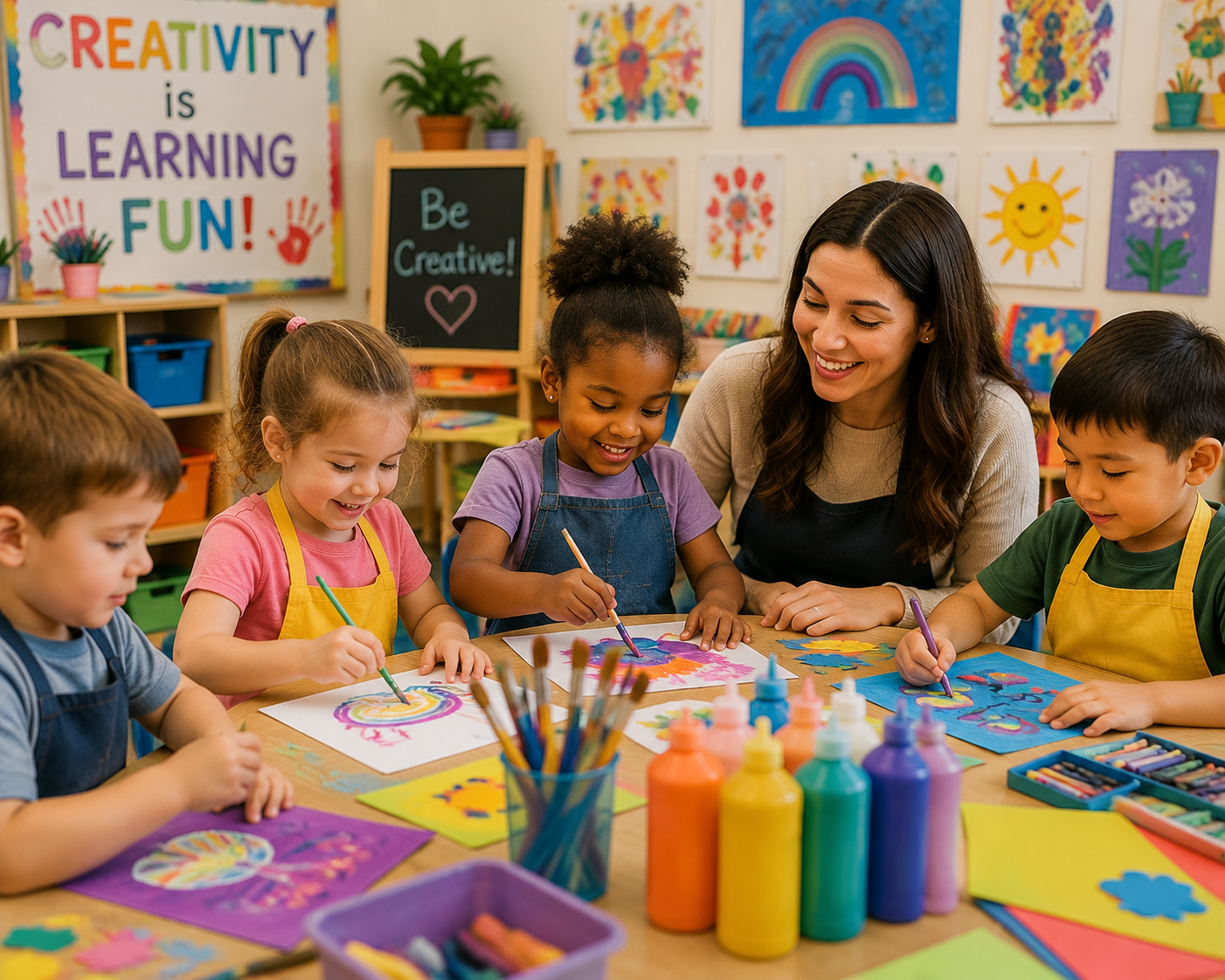
Art is more than a finished picture. When children paint, draw, print, sculpt, tear, glue, mix, build, and experiment, they are developing skills across multiple areas of learning. A strong art experience gives children time, materials, encouragement, and the freedom to make their own choices.
Simple, flexible experiences designed to encourage exploration rather than imitation.
Offer paint, brushes, sponges, rollers, and different surfaces. Let children decide what they want to create and how they want to use the materials.
Provide paper scraps, fabric, natural materials, cardboard, yarn, and other safe loose parts. Children can arrange, layer, tear, overlap, and glue materials in their own way.
Invite children to mix colors, compare shades, make predictions, and discover what happens when different colors and materials come together.
Use clay, play dough, recycled boxes, paper tubes, or other materials to encourage children to build, shape, balance, and invent.
Choose an experience based on the materials, skills, or type of creative exploration you want to encourage.
Explore color, texture, movement, tools, and large or small scale painting.
Give children opportunities to make marks, lines, shapes, patterns, and pictures.
Cut, tear, layer, arrange, glue, and combine materials to create unique designs.
Investigate color mixing, matching, contrast, shades, and unexpected discoveries.
Explore smooth, rough, soft, bumpy, sticky, and other interesting surfaces.
Build, shape, balance, stack, and transform materials into three dimensional creations.
Flexible classroom ideas that can be adapted for different ages, developmental levels, and available materials.
Invite children to paint with sponges, cotton swabs, cardboard pieces, combs, toy wheels, or other safe classroom tools. Encourage them to notice the marks each tool makes.
Offer a variety of drawing tools and invite children to experiment with straight, curved, zigzag, dotted, heavy, and light lines. Ask children what their lines could become.
Set out paper, fabric, yarn, cardboard, tissue paper, and other safe loose parts. Children choose what to combine and create their own collage.
Let children experiment with primary colors and discover what happens when they mix two colors together. Focus on observation and conversation rather than a required result.
Place different textured materials beneath paper and invite children to explore the marks and patterns created through rubbing, printing, or painting.
Provide recycled boxes, tubes, paper, tape, and other safe construction materials. Encourage children to design something that stands, moves, balances, or represents an idea.
Open-ended art experiences support development while giving children meaningful opportunities to make choices and share their ideas.
Children generate ideas, experiment with possibilities, and discover that there can be many ways to approach a creative problem.
Grasping tools, squeezing materials, tearing paper, painting, drawing, cutting, and gluing provide opportunities to strengthen hand and finger control.
Children make decisions about materials, placement, balance, color, shape, and design as they work through their ideas.
Children can communicate ideas, interests, experiences, and feelings through materials and creative choices.
Young children do not need every art experience to look the same. Instead of showing children exactly what to make, provide interesting materials, introduce a simple invitation, and give them time to explore. Ask questions such as, “What do you notice?”, “What could you try next?”, or “Tell me about what you made.” This keeps the focus on curiosity, creativity, and the child's own thinking.