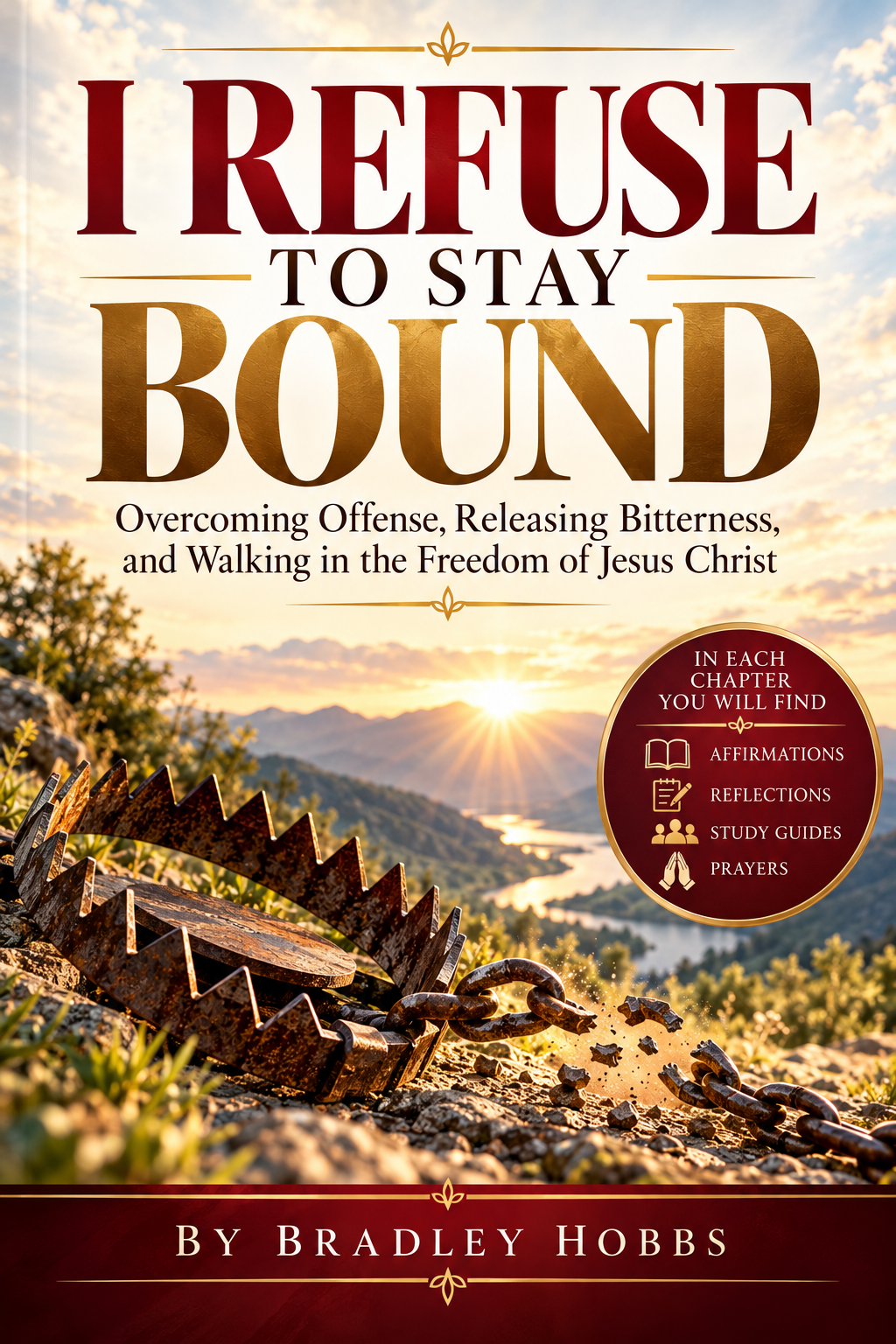
Continue your journey beyond the page through Scripture, intentional reading, personal application, and deeper study of what it means to walk in the freedom of Jesus Christ.
Growing in truth. Walking in freedom.
Let the Journey Continue
I Refuse to Stay Bound is an invitation to examine the condition of the heart, confront the power of offense, and pursue the freedom that comes through Jesus Christ. Reading is an important beginning, but the message becomes meaningful as we allow truth to shape our choices, relationships, and responses.
This resource center accompanies the book with Scripture references, a seven day reading journey, guidance for group study, and suggestions for further exploration. It does not replace the teaching, reflections, prayers, or affirmations already included throughout the chapters.
Apostolic Teaching Resource · Church and Group Study
12 Week Syllabus and Curriculum
I Refuse to Stay Bound is a Scripture centered study on overcoming offense, releasing bitterness, practicing forgiveness with wisdom, and walking in the freedom of Jesus Christ. This twelve week plan provides a ready to use framework for churches, small groups, ministry teams, and personal study.
Course Syllabus
Course length: 12 weeks, one guided session per week.
Course purpose: To help participants examine their own hearts through Scripture, recognize how offense and bitterness can shape responses, and practice forgiveness, accountability, wise boundaries, and spiritual growth in Jesus Christ.
Required resource:I Refuse to Stay Bound by Bradley Hobbs. Participants should read the assigned portion of the book before each session and bring a Bible and a notebook.
Learning Outcomes
Identify personal responses to hurt without denying that harm occurred.
Study biblical teaching about offense, forgiveness, mercy, repentance, and accountability.
Distinguish forgiveness from restored trust and reconciliation.
Recognize the importance of healthy boundaries, safety, and wise counsel.
Apply Scripture to personal choices, attitudes, words, and relationships.
Develop a practical plan for continuing to walk in the freedom of Jesus Christ.
Suggested Weekly Session Format
Opening prayer and review of the previous week's personal application.
Read the assigned book section and the week's Scripture passages in context.
Teach and discuss the central theme, allowing space for thoughtful questions.
Complete the personal reflection and practical application.
Close with prayer. Sharing personal experiences is always voluntary.
Leader guidance: Keep discussion focused on Scripture and personal application. Do not pressure participants to disclose painful experiences, name other people, or reconcile in situations where safety and accountability have not been established.
Twelve Week Study Plan
Read the corresponding chapter or chapters in the book each week, following the book's existing order. The weekly themes below organize the course without replacing or renaming the book's chapter titles.
WEEK 01The Decision to Walk in FreedomView lesson +
WEEK 01
The Decision to Walk in Freedom
Assigned reading: Introduction, “The Decision to Walk in Freedom,” and Chapter 1, “When the Wound Comes from the House of God,” plus Chapter 2, “Betrayed by Those You Trusted.”
Focus: Begin with willingness, humility, and an honest examination of the heart.
Scripture: Psalm 139:23–24; John 8:31–32.
Personal application: Write down one area where you want God's truth to shape your response.
WEEK 02Recognizing OffenseView lesson +
WEEK 02
Recognizing Offense
Assigned reading: Chapters 3–4: “The Silence That Protects the Wrong Things” and “The Poison of Bitterness.”
Focus: Understand how hurt and offense can influence thoughts, words, decisions, and relationships.
Scripture: Proverbs 18:19; Hebrews 12:14–15.
Personal application: Notice your own responses to hurt without assigning blame to others during the exercise.
WEEK 03Examining the HeartView lesson +
WEEK 03
Examining the Heart
Assigned reading: Chapters 5–6: “When Forgiveness Feels Impossible” and “The Trap of Playing God.”
Focus: Invite correction and distinguish self examination from condemnation.
Scripture: Psalm 51:10; James 1:19–20.
Personal application: Identify one attitude, habit, or response that needs prayerful attention.
WEEK 04The Weight of BitternessView lesson +
WEEK 04
The Weight of Bitterness
Assigned reading: Chapters 7–8: “The Church Must Repent Before It Can Heal” and “When the Wounded Become the Wounders.”
Focus: Consider how resentment can take root and affect spiritual and relational life.
Scripture: Ephesians 4:31–32; Hebrews 12:15.
Personal application: Name privately what you need to bring honestly before Jesus in prayer.
WEEK 05Choosing ForgivenessView lesson +
WEEK 05
Choosing Forgiveness
Assigned reading: Chapters 9–10: “The Difference Between Forgiveness and Reconciliation” and “The Freedom of Setting Boundaries Without Guilt.”
Focus: Study forgiveness as a deliberate response to the teaching of Jesus, not as denial of wrongdoing.
Scripture: Matthew 6:14–15; Colossians 3:12–13.
Personal application: Write a personal prayer asking Jesus to help you take the next honest step toward forgiveness.
WEEK 06Forgiveness, Repentance, and AccountabilityView lesson +
WEEK 06
Forgiveness, Repentance, and Accountability
Assigned reading: Chapters 11–12: “When Apologies Are Not Enough” and “The Danger of Spiritual Manipulation.”
Focus: Explore the relationship between mercy, changed conduct, responsibility, and truth.
Scripture: Luke 17:3–4; 2 Corinthians 7:9–11.
Personal application: Consider where accountability or a change in your own conduct may be needed.
WEEK 07Forgiveness and ReconciliationView lesson +
WEEK 07
Forgiveness and Reconciliation
Assigned reading: Chapters 13–14: “Healing When the Church Has Become the Wound” and “The Courage to Trust Again.”
Focus: Recognize that forgiveness and reconciliation are related but not identical.
Scripture: Romans 12:18; Matthew 5:23–24.
Personal application: Identify what is within your responsibility and what requires another person's willing participation.
WEEK 08Trust, Wisdom, and BoundariesView lesson +
WEEK 08
Trust, Wisdom, and Boundaries
Assigned reading: Chapters 15–16: “When God Restores What Betrayal Tried to Destroy” and “The Prison of Remembering.”
Focus: Consider how forgiveness can coexist with discernment, safety, and appropriate boundaries.
Scripture: Proverbs 4:23; Proverbs 22:3.
Personal application: Write one wise boundary or support step that may help protect peace and well being.
WEEK 09Responding Without RetaliationView lesson +
WEEK 09
Responding Without Retaliation
Assigned reading: Chapters 17–18: “The Freedom of Letting Go of What You Cannot Change” and “The Lies We Believe After Betrayal.”
Focus: Learn to resist revenge and allow Scripture to guide a faithful response to conflict.
Scripture: Romans 12:17–21; 1 Peter 3:9.
Personal application: Plan a calm, truthful, and responsible response to a difficult situation.
WEEK 10Walking in Truth and Spiritual FreedomView lesson +
WEEK 10
Walking in Truth and Spiritual Freedom
Assigned reading: Chapters 19–21: “When Forgiveness Meets Justice,” “The Weight of Unforgiveness in Relationships,” and “The Battle Between the Wound and the Word.”
Focus: Connect freedom in Jesus Christ with continuing obedience to His Word.
Scripture: John 8:31–36; Galatians 5:1.
Personal application: Choose one truth from Scripture to remember and practice during the week.
WEEK 11Living Out What You Have LearnedView lesson +
WEEK 11
Living Out What You Have Learned
Assigned reading: Chapters 22–24: “Breaking the Chains of Shame,” “The Courage to Speak When Silence Is No Longer Faithfulness,” and “When People Misunderstand Your Healing.”
Focus: Apply the study to daily choices, communication, relationships, and spiritual maturity.
Scripture: Ephesians 4:15; James 1:22–25.
Personal application: Review your notes and identify a specific change you can continue practicing.
WEEK 12Continuing in FreedomView lesson +
WEEK 12
Continuing in Freedom
Assigned reading: Chapters 25–27: “Rebuilding Your Life After the Battle,” “The Testimony That Survives the Fire,” and “The Church Must Become a Place of Healing.”
Focus: Review the course, give thanks for growth, and prepare for continued personal application.
Personal application: Create a personal plan for prayer, Scripture reading, accountability, and ongoing growth.
Course Completion Reflection
At the final session, invite each participant to complete a personal reflection: What truth has challenged me most? What have I learned about forgiveness and responsibility? What boundary, habit, or response do I need to continue addressing? What will help me remain grounded in Scripture and keep walking in the freedom of Jesus Christ?
Completion can be recognized through participation, weekly personal application, and a written reflection. No participant should be required to disclose private or traumatic experiences to complete the course.
Scripture Reference Guide
Scripture gives us a foundation for examining our hearts, understanding our responsibilities, and seeking the wisdom of God. Use the subjects below to explore passages connected to the central themes of the book.
These references are starting points for personal study. Read each passage in its surrounding context, paying attention to whom it addresses and what it teaches.
Forgiveness and Mercy
Matthew 6:14–15 examines forgiveness in the life of a disciple.
Matthew 18:21–35 presents Jesus' teaching about forgiveness and mercy.
Ephesians 4:31–32 calls believers away from bitterness and toward kindness, compassion, and forgiveness.
Colossians 3:12–13 connects compassion, patience, and forgiveness with the life of a believer.
Consider how receiving mercy from God should influence the way you respond to people who have hurt you.
Offense, Anger, and Bitterness
Hebrews 12:14–15 warns against allowing a root of bitterness to grow.
James 1:19–20 teaches believers to be quick to hear, slow to speak, and slow to anger.
Proverbs 19:11 considers patience and the wisdom of overlooking certain offenses.
Ephesians 4:26–27 addresses anger and warns against giving the devil an opportunity.
Examine the difference between acknowledging that something was wrong and allowing resentment to govern your decisions.
Repentance and Examination of the Heart
Psalm 139:23–24 expresses a desire for God to search the heart and lead in the right way.
Psalm 51:10 expresses the desire for a clean heart and a renewed spirit.
2 Corinthians 13:5 calls believers to examine themselves.
1 John 1:9 addresses confession and God's faithfulness to forgive and cleanse.
Ask God to reveal not only the wounds you carry but also the attitudes, words, and actions that require your own repentance.
Reconciliation, Repentance, and Accountability
Matthew 5:23–24 emphasizes taking responsibility for reconciliation with a brother or sister.
Matthew 18:15–17 describes a process for addressing wrongdoing within the community of believers.
Luke 17:3–4 addresses correction, repentance, and forgiveness.
2 Corinthians 7:9–11 discusses godly sorrow and the fruit of repentance.
Consider the difference between offering forgiveness and rebuilding a relationship. Reconciliation requires wisdom, and meaningful restoration may involve repentance, accountability, and changed behavior.
Wisdom, Boundaries, and Discernment
Proverbs 4:23 emphasizes guarding the heart because life flows from it.
Proverbs 22:3 considers the wisdom of recognizing danger and responding prudently.
Matthew 10:16 calls for both shrewdness and innocence.
Romans 12:18 instructs believers to live peaceably with others as far as it depends on them.
Consider how to pursue peace without denying reality, abandoning wisdom, or permitting continued harm.
Freedom in Jesus Christ
John 8:31–36 connects abiding in Jesus' word with truth and freedom.
2 Corinthians 3:17 speaks of the Spirit of the Lord and liberty.
Galatians 5:1 calls believers to stand firm in the freedom Christ provides.
Romans 8:1–2 addresses freedom from condemnation and the law of the Spirit of life in Christ Jesus.
Reflect on the difference between knowing biblical truth intellectually and allowing that truth to shape your daily walk with Jesus.
Love, Truth, and Christian Character
1 Corinthians 13:4–7 describes the character and conduct of love.
Ephesians 4:15 speaks of speaking the truth in love.
Micah 6:8 emphasizes justice, mercy, and walking humbly with God.
Romans 12:17–21 teaches believers not to repay evil for evil and calls them to overcome evil with good.
Examine whether your responses reflect both the truth of God's Word and the character of Jesus Christ.
A Note on Scripture Study
A single verse should not be used to silence someone who has been harmed or to excuse wrongdoing. Read passages in context and consider the full biblical teaching on truth, mercy, justice, repentance, and responsibility.
This seven day reading journey invites you to slow down, engage with the message of I Refuse to Stay Bound, and consider how biblical truth applies to your daily walk with Jesus Christ.
Rather than rushing through the book, approach each day with an open heart. Read the assigned portion thoughtfully, examine the Scriptures referenced in the text, and allow yourself time to consider what you are learning.
Read the chapters in their published order. Divide the 27 chapters across the seven days according to their length. Some days may require more reading than others. This guide supplements the book and does not replace its existing teaching, reflections, prayers, or affirmations.
DAY01
Begin with an Open Heart
Start with willingness
Begin with the introduction and the opening portion of the book. Approach the message with a willingness to examine your own heart rather than concentrating only on the faults of others.
DAY02
Recognize the Power of Offense
Notice your responses
Continue reading in the established chapter order. Consider how unresolved hurt, resentment, and personal responses can influence your thoughts, decisions, and relationships.
DAY03
Examine Your Own Heart
Invite honest reflection
Continue through the next portion of the book. Be willing to recognize attitudes, words, and choices that may need correction. Honest self examination requires humility and a willingness to respond to the truth of God's Word.
DAY04
Understand Forgiveness and Responsibility
Practice wisdom
Pay attention to what the book teaches about forgiveness, repentance, accountability, and reconciliation. Forgiveness should never be used to excuse wrongdoing or prevent appropriate boundaries.
DAY05
Choose Truth Over Bitterness
Let truth guide you
Continue through the manuscript. Reflect on the difference between acknowledging that you have been hurt and allowing that hurt to govern your life. Consider how Scripture can guide your responses.
DAY06
Walk in Wisdom and Freedom
Apply what you learn
Read the next portion of the book, moving toward its conclusion. Consider how your relationship with Jesus Christ should shape your choices, boundaries, relationships, and daily conduct.
DAY07
Reflect, Respond, and Continue
Carry the message forward
Complete any remaining chapters. Return to the teaching, Scripture references, prayers, and affirmations that spoke to you most clearly. Consider how to keep applying biblical truth in your daily walk.
I Refuse to Stay Bound may serve as a starting point for conversations about forgiveness, offense, bitterness, accountability, and spiritual freedom. This framework can help pastors, teachers, and group facilitators create thoughtful discussions without duplicating the chapter material.
1. Establish the Purpose
Explain that the goal is to examine Scripture, consider personal responsibility, and grow in the character of Jesus Christ. The group is not a place to identify, accuse, or publicly confront other people.
2. Read the Assigned Chapter
Ask participants to read the selected chapter before meeting when possible. During the session, focus on the chapter's existing teaching and biblical foundations.
3. Examine the Scripture
Read the biblical passages in context. Invite participants to consider what the text actually teaches and how it relates to the subject under discussion.
4. Encourage Honest Reflection
Allow participants to think privately before sharing. Personal disclosure should remain voluntary. No one should be pressured to recount painful experiences or reveal confidential details.
5. Distinguish Forgiveness from Reconciliation
Make room for an honest discussion about repentance, trust, accountability, and safety. Do not suggest that forgiveness requires a person to remain in a harmful situation or immediately restore a relationship.
6. Encourage Practical Application
Invite participants to identify a personal next step related to their own choices, attitudes, or boundaries. Keep the emphasis on personal application rather than trying to control another person's response.
7. Close with Prayer
Allow time for prayer using the prayer already included in the assigned chapter. Respect participants who prefer to pray privately or who are not ready to share aloud.
Guidance for Group Leaders
Protect confidentiality while explaining its limits when safety concerns arise. Do not use forgiveness teaching to silence reports of abuse, discourage appropriate reporting, or shield leaders from accountability. When serious harm is disclosed, respond with care and help the person access appropriate support.
Understanding Biblical Forgiveness and Freedom
Some of the most difficult conversations about forgiveness arise when biblical principles are confused with expectations that Scripture does not require in every circumstance. These distinctions can help readers study the subject carefully.
Forgiveness and Reconciliation
Forgiveness and reconciliation are related, but they are not identical. Reconciliation concerns the restoration of a relationship. Rebuilding a damaged relationship may require honesty, repentance, accountability, and time.
Study: Matthew 18:15–17 and Romans 12:18.
Forgiveness and Trust
Forgiveness does not automatically establish that another person is trustworthy. Trust develops through demonstrated honesty, responsibility, consistency, and changed behavior.
Study: Proverbs 22:3 and Luke 17:3–4.
Grace and Accountability
Grace is not permission to continue wrongdoing. Biblical mercy must not become an excuse to avoid repentance or the consequences of harmful choices.
Study: 2 Corinthians 7:9–11 and Galatians 6:1.
Peace and Boundaries
Pursuing peace does not mean pretending that harm never happened. Wise boundaries can coexist with a sincere desire to avoid retaliation and pursue what is right.
Study: Romans 12:17–21 and Proverbs 4:23.
Love and Truth
Christian love is not the denial of truth. Speaking honestly, correcting wrongdoing appropriately, and treating people with dignity belong together.
Study: Ephesians 4:15 and 1 Corinthians 13:4–7.
Freedom and Personal Responsibility
Spiritual freedom is not permission to act without wisdom. It calls believers to let the truth of Jesus Christ shape their decisions, conduct, and treatment of others.
Study: John 8:31–36 and Galatians 5:1.
Further Study and Support
The following resources can help readers explore Scripture and seek appropriate assistance when a situation requires more than personal reflection.
Bible Gateway
Look up Scripture references, compare Bible translations, and read passages in their surrounding context.
Consider speaking with a trustworthy, accountable pastor or ministry leader when spiritual guidance would be helpful. Choose someone who respects appropriate boundaries and takes concerns seriously.
Professional Support
If betrayal, abuse, trauma, or ongoing conflict is affecting your well-being, a qualified mental health professional or appropriate support organization may help you work through the situation safely.
External websites are independently operated and may change their content, availability, or policies. Their inclusion does not imply endorsement of every resource they provide.
Downloadable Study Materials
Use these printable materials alongside your reading and group study. Student resources are available for everyone participating in the study.
Student Handouts
Printable handouts to support personal reflection and weekly study.
Read the book at your own pace. Use the Scripture Reference Guide when you want to examine a particular subject more closely. Return to the existing prayers and reflections within the chapters as needed.
For Church and Group Study
Use the Guided Reading Journey to organize the reading schedule and the group study framework to guide discussion. Keep Scripture and the book's actual teaching at the center of each meeting.
For Further Biblical Exploration
Follow the references in the Scripture guide. Read the complete passages, compare translations when helpful, and consider the wider biblical context.
For Continued Growth
Return to the resources whenever you need to revisit a subject. Growth is not measured only by how quickly a book is completed, but also by how faithfully its truth informs daily life.
Continue the Journey
The resources on this page are here to support your engagement with the book, not replace it. The heart of the journey remains the same: to confront what keeps us bound, examine ourselves honestly before God, and pursue a life shaped by the truth and freedom found in Jesus Christ.
Continue reading. Continue studying the Word. Continue allowing God to work in your heart.