

Touch
Sensory Bins
Children explore different textures, materials, and objects while building language and discovery skills.
Sensory activities encourage children to touch, listen, observe, create, and investigate while building curiosity, language, problem solving, and confidence through hands-on play.
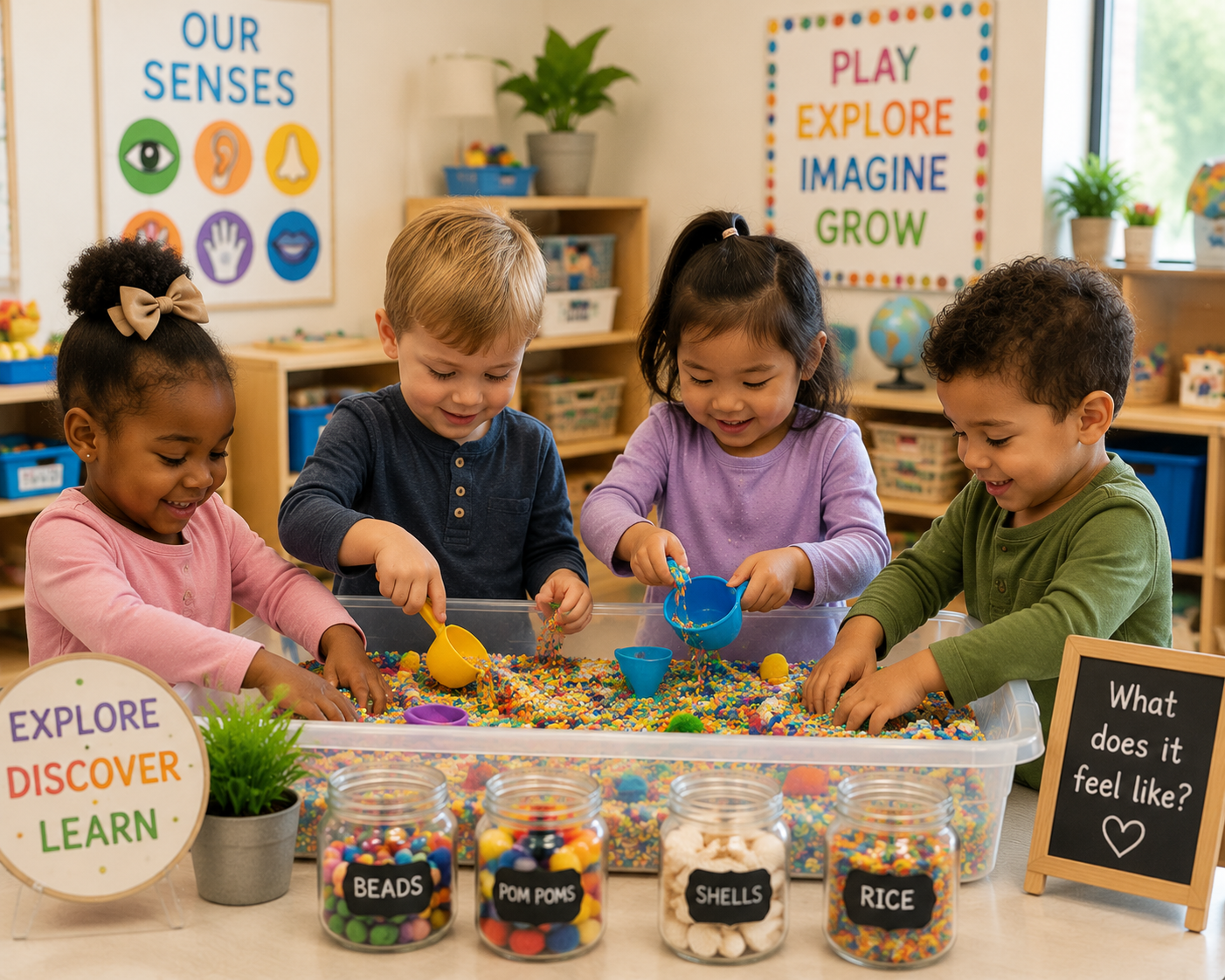
Young children learn by exploring the world around them. Sensory experiences help children investigate materials, describe what they notice, develop vocabulary, strengthen fine motor skills, and build confidence through discovery.
Hands-on experiences that encourage children to explore, observe, investigate, and discover.
Children explore different textures, materials, and objects while building language and discovery skills.

Children compare soft, rough, smooth, and bumpy materials while describing what they notice.

Children explore music, rhythm, and everyday sounds through listening activities.

Children investigate colors, patterns, light, and visual changes.
Support children's curiosity through meaningful sensory experiences.
Explore materials, textures, and objects through play.
Investigate pouring, measuring, and cause and effect.
Compare materials using touch and observation.
Discover rhythm, volume, and listening skills.
Explore color mixing, patterns, and visual changes.
Investigate natural materials through sensory experiences.
Simple classroom experiences that encourage exploration through the senses.
Children explore hidden objects, scoop materials, and describe what they discover.
Children search for objects that feel smooth, rough, soft, or hard.
Children create instruments and explore different sounds.
Children mix colors, make predictions, and observe changes.
Sensory experiences help children explore, communicate, problem solve, and understand the world around them.
Children investigate materials, notice differences, and learn through hands-on discovery.
Children compare, predict, sort, classify, and solve problems.
Children build vocabulary by describing textures, sounds, colors, and experiences.
Scooping, pouring, squeezing, and manipulating materials strengthen hands.
Create meaningful sensory experiences that encourage curiosity and discovery.
Encourage children to describe, predict, and explain what they notice.
Provide a variety of textures, objects, and sensory experiences.
Use words like rough, smooth, heavy, light, loud, and quiet.
Allow children to explore, repeat experiences, and discover.
Choose sensory experiences that support children's developmental stages.
Textures, sounds, movement, and simple exploration.
Explore →Sensory bins, water play, colors, and discovery.
Explore →Investigation activities, sorting, comparing, and describing.
Explore →Science exploration, experiments, and sensory problem solving.
Explore →Sensory activities support approaches to learning, cognitive development, language development, fine motor skills, creativity, and children's ability to explore their environment.