
Math
Sorting & Classification
Children compare objects by color, shape, size, texture, and purpose while building early math skills.
Cognitive activities encourage children to ask questions, solve problems, make connections, and understand the world through hands-on exploration and play.
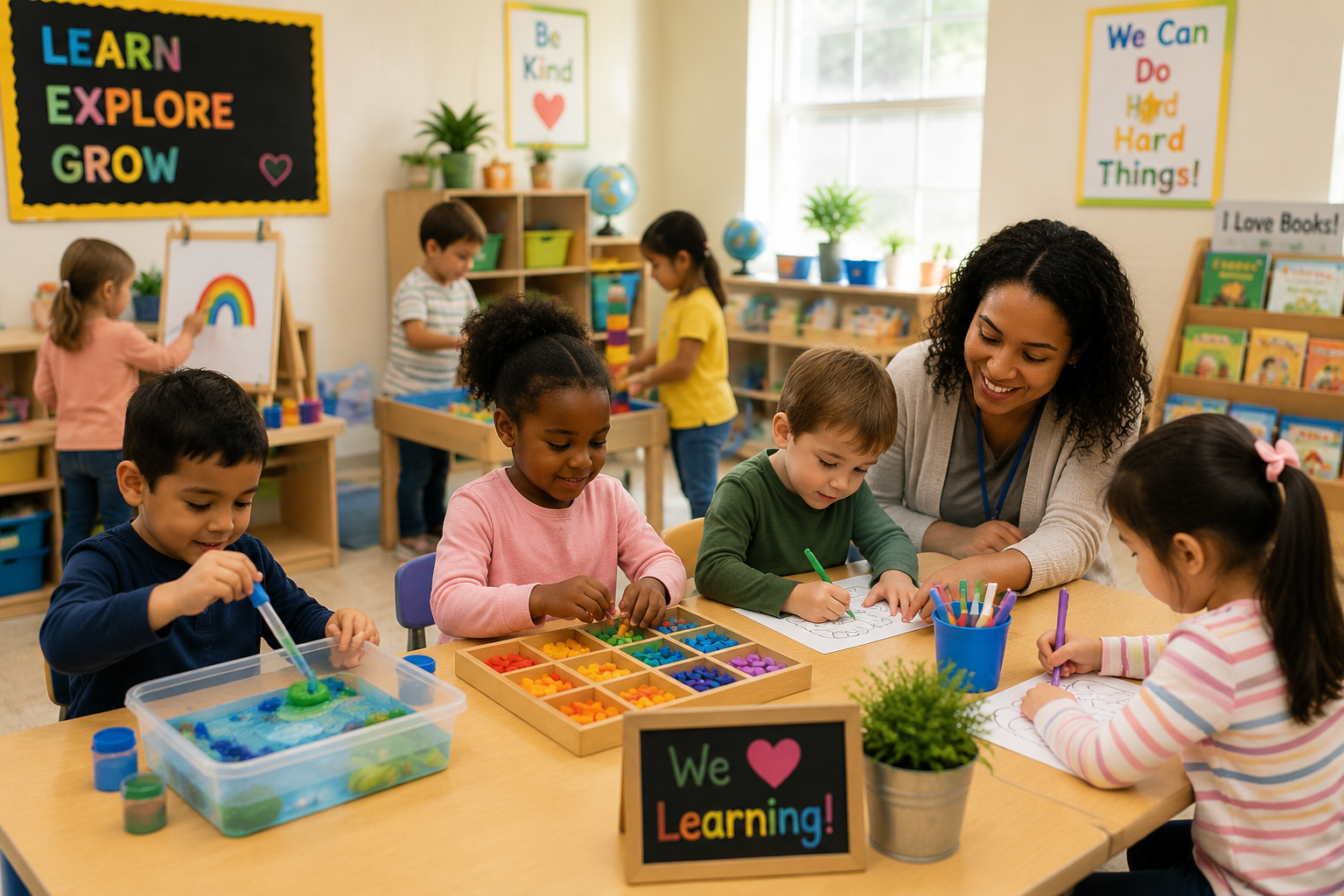
Children develop cognitive skills as they explore, experiment, compare, predict, and solve problems. Every classroom experience becomes an opportunity for discovery.
Hands-on experiences that help children think, reason, investigate, and solve problems.
Children compare objects by color, shape, size, texture, and purpose while building early math skills.

Encourage children to plan, experiment, test ideas, and discover solutions.

Children observe, predict, investigate, and learn how the world works.

Activities that strengthen attention, recall, concentration, and recognition skills.
Build early reasoning skills through meaningful classroom experiences.
Classify objects, identify patterns, and compare materials.
Explore numbers, counting, measurement, and patterns.
Observe, predict, experiment, and investigate.
Design, create, test ideas, and solve problems.
Strengthen attention, focus, and recall.
Discover repetition, relationships, and predictions.
Simple activities teachers can prepare using everyday classroom materials.
Children sort buttons, blocks, or classroom objects by color while developing classification skills.
Children count, compare, and organize collections of objects.
Children use blocks and recycled materials to design and test their ideas.
Children match pictures, objects, or symbols while practicing recall.
Every activity creates opportunities for children to think, explore, and understand the world around them.
Children learn to ask questions, make predictions, test ideas, and find solutions.
Children explore materials, investigate ideas, and learn through observation.
Children develop counting, sorting, measuring, and pattern recognition skills.
Children connect ideas, make choices, and understand relationships.
Small changes in the classroom create powerful learning opportunities.
Encourage children to explain their thinking with questions like "Why?" and "How do you know?"
Give children time to investigate, experiment, and discover independently.
Provide activities that encourage children to think beyond the first solution.
Focus on children's process, effort, and creativity.
Choose activities that match children's developmental stages.
Cause and effect, sensory exploration, and early problem solving.
Explore →Sorting, matching, simple puzzles, and discovery.
Explore →Patterns, counting, building, and investigations.
Explore →Reasoning, experiments, math thinking, and problem solving.
Explore →Cognitive activities support children's approaches to learning, reasoning skills, scientific thinking, mathematical thinking, and exploration.