Math
Measure Buildings
Measure towers with cubes, rulers, tape measures, and nonstandard units.
Children investigate the buildings that make up their communities while discovering architecture, construction, engineering, neighborhoods, and the many ways buildings help people live, work, learn, and play.
Buildings are everywhere children go. Homes, schools, libraries, stores, hospitals, churches, fire stations, and restaurants all provide opportunities for investigation. As children explore buildings, they naturally develop mathematical thinking, scientific inquiry, engineering skills, language, creativity, and social understanding.
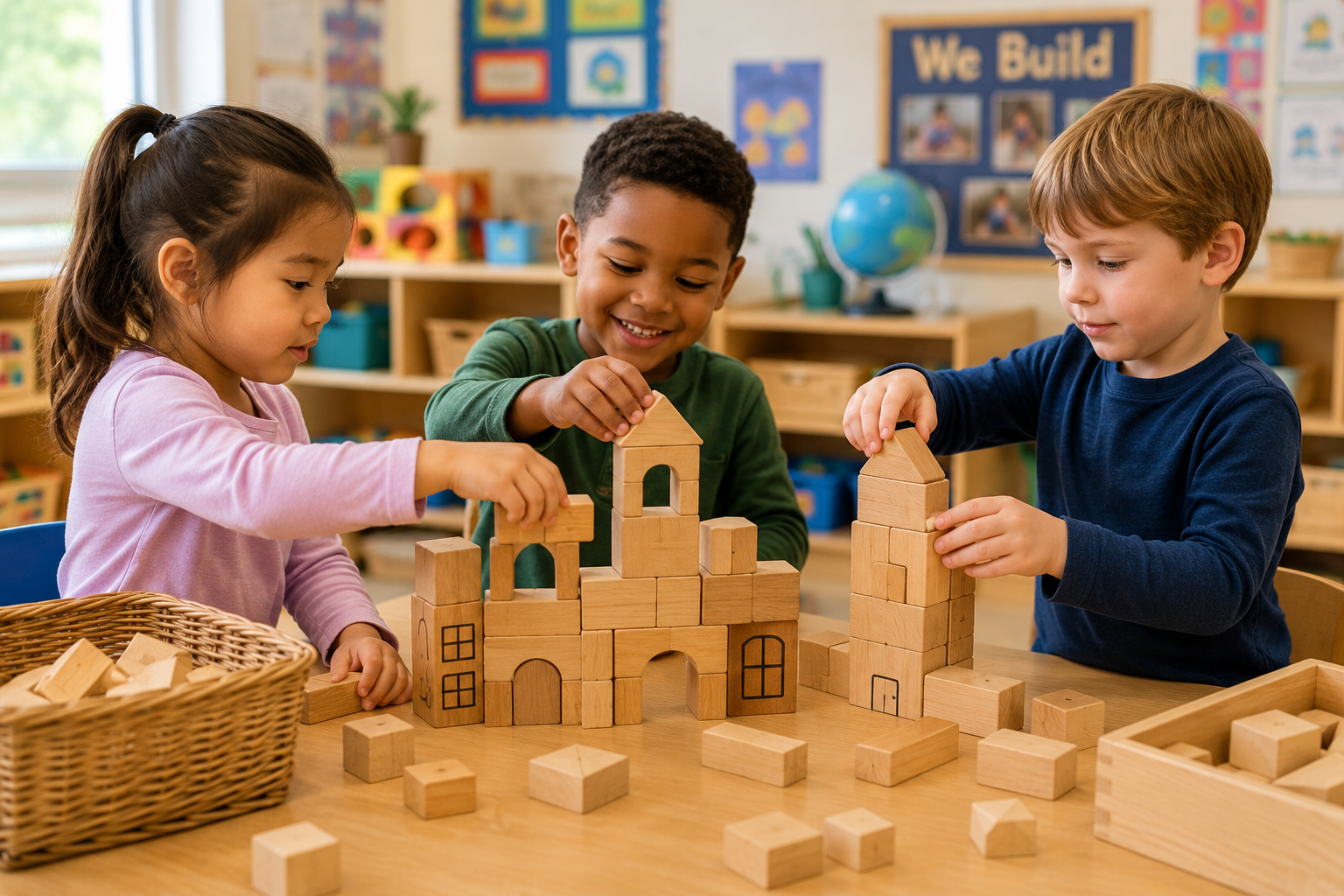
Encourage children to ask questions, make predictions, observe carefully, and solve problems throughout the study.
How are buildings alike and different? What makes a building useful?
Discover architects, engineers, construction workers, electricians, plumbers, and many other community helpers.
Investigate wood, brick, steel, concrete, glass, stone, and recycled materials.
Explore how buildings change depending on weather, culture, purpose, and location around the world.
Weeks
Activities
Interest Areas
Hands On Learning
Each week builds upon children's questions while encouraging exploration, engineering, creativity, and problem solving.
What is a building? Children observe buildings around their homes, school, and community while identifying different types and purposes.
How are buildings made? Explore construction workers, tools, blueprints, building materials, and engineering.
Design and build using blocks, recycled materials, cardboard, wood pieces, and loose parts while testing strength and stability.
Compare homes and buildings around the world while designing an imaginative community together.
Children develop skills across every learning domain through meaningful investigations.
Describe buildings, ask questions, compare structures, and introduce new vocabulary.
Measure height, compare sizes, count windows, identify shapes, and create patterns.
Investigate balance, stability, gravity, weather, and building materials.
Design, build, test, redesign, and solve construction challenges.
Draw blueprints, paint buildings, design neighborhoods, and build imaginative cities.
Work cooperatively while planning, sharing materials, and solving problems together.
Introduce new words naturally during conversations, books, construction projects, and investigations.
Home, school, apartment, hospital, library, church, store, office.
Blueprint, crane, hammer, excavator, cement, foundation, scaffold.
Brick, wood, steel, glass, stone, concrete, metal, roof.
Tall, short, wide, narrow, heavy, light, longer, stronger.
Invite families to help gather recyclable materials before beginning the study.
Cereal boxes, shipping boxes, tissue boxes, shoe boxes, and food containers.
Paper towel rolls, tissue tubes, mailing tubes, and small cylinders.
Wood scraps, blocks, foam bricks, stones, popsicle sticks, corks, and loose parts.
Tape measures, rulers, clipboards, pencils, graph paper, and child safe tools.
Extend children's learning throughout every classroom center with meaningful building experiences.
Build homes, bridges, schools, hospitals, towers, neighborhoods, and entire cities while exploring balance, stability, measurement, and engineering.
Transform the classroom into a construction site with hard hats, blueprints, measuring tapes, tool belts, safety vests, and pretend building materials.
Compare bricks, wood, glass, stone, and metal while investigating which materials are strongest, waterproof, flexible, or heavy.
Read books about construction workers, famous buildings, homes around the world, neighborhoods, and community helpers.
Paint skylines, design colorful houses, create neighborhood murals, build cardboard sculptures, and draw architectural blueprints.
Draw building plans, label construction tools, create neighborhood maps, and write signs for classroom buildings.
Explore sand, gravel, rocks, dirt, water, wooden blocks, and loose construction materials through open ended investigation.
March like construction workers, pretend to operate heavy equipment, sing building songs, and move like cranes, bulldozers, and dump trucks.
Strengthen communication, vocabulary, and early reading skills throughout the Buildings Study.
Discuss buildings, neighborhoods, community helpers, and construction while asking prediction and comprehension questions.
Introduce words such as architect, blueprint, foundation, structure, construction, engineer, roof, wall, and window.
Invite children to describe the buildings they designed while adults record their words.
Create classroom books featuring children's homes, favorite buildings, and community landmarks.
Children naturally explore mathematics and science while designing, constructing, comparing, and testing buildings.
Measure towers with cubes, rulers, tape measures, and nonstandard units.
Test which building designs stay standing during wind, shaking, or added weight.
Design bridges that support toy vehicles using cardboard, blocks, craft sticks, and recycled materials.
Encourage children to redesign structures after testing what worked well and what could be improved.
Take the Buildings Study outside by observing real structures, exploring neighborhoods, and designing with natural materials.
Walk around your school or neighborhood identifying homes, businesses, churches, schools, fire stations, and other community buildings.
Take photographs of interesting buildings and compare windows, doors, roofs, colors, and shapes back in the classroom.
Use sticks, rocks, pinecones, leaves, and logs to create miniature houses and shelters outdoors.
Estimate and compare the heights and widths of buildings, fences, playground structures, and trees.
Invite families to continue learning about buildings and construction together at home.
Families identify different buildings while discussing who uses each one and why it is important.
Take pictures of interesting buildings and share them with the class.
Collect clean boxes, tubes, cartons, and containers to use during classroom construction projects.
Observe a construction project from a safe distance and discuss the equipment and workers.
The Buildings Study naturally supports every area of children's development.
Children describe observations, ask questions, listen to stories, and expand vocabulary.
Cooperate with classmates while planning, designing, and constructing together.
Develop reasoning, prediction, engineering, and problem solving skills.
Strengthen fine and gross motor skills through measuring, building, carrying, stacking, and creating.
Observe children's thinking throughout the investigation rather than focusing only on finished projects.
Notice how children plan, revise, and improve their structures.
Record children's explanations, predictions, and descriptions during investigations.
Save blueprints, drawings, writing samples, and photographs of finished buildings.
Compare children's engineering ideas and vocabulary from the beginning and end of the study.
Allow children's questions and discoveries to guide the direction of the investigation.
Gather recycled materials throughout the study so children always have new construction possibilities.
Photograph each stage of children's building projects to celebrate growth and persistence.
"What might happen if...?" and "How could we make it stronger?" encourage deeper thinking.
Read quality nonfiction and fiction books throughout the investigation to encourage vocabulary, questioning, and curiosity.
Read books showing how homes, bridges, skyscrapers, schools, and community buildings are constructed.
Learn about architects, engineers, electricians, plumbers, roofers, and builders who work together.
Compare houses from different countries, climates, and cultures while celebrating diversity.
Explore neighborhoods, famous landmarks, and buildings that make communities unique.
Combine movement, rhythm, and imaginative play while learning about construction and community helpers.
Pretend to drive dump trucks, bulldozers, cranes, cement mixers, and excavators around the classroom.
Sing songs about building homes, neighborhoods, community helpers, and construction equipment.
Move carefully while balancing foam blocks, beanbags, or lightweight boxes like construction workers.
Play a construction themed version of Simon Says using actions such as hammer, lift, carry, measure, and build.
Invite children to solve real engineering problems using simple classroom materials.
Build the tallest free standing tower using blocks, recycled materials, or cups.
Use a fan to discover which structures remain standing during strong winds.
Create a bridge that supports toy cars using cardboard, craft sticks, and tape.
Identify and use squares, rectangles, circles, triangles, and cylinders while designing buildings.
Display new words with photographs and real objects throughout the study.
Architect, blueprint, foundation, scaffold, engineer, contractor.
Brick, concrete, wood, steel, glass, stone, metal, insulation.
Apartment, school, library, hospital, museum, church, office, restaurant.
Height, width, length, balance, estimate, compare, measure, stronger.
Extend children's investigations with related curriculum studies.
Transform everyday boxes into imaginative creations while exploring design and engineering.
Investigate trees, wood, nature, habitats, and outdoor exploration.
Discover how tools and machines help people build and solve problems.
Reuse construction materials while learning to care for our environment.